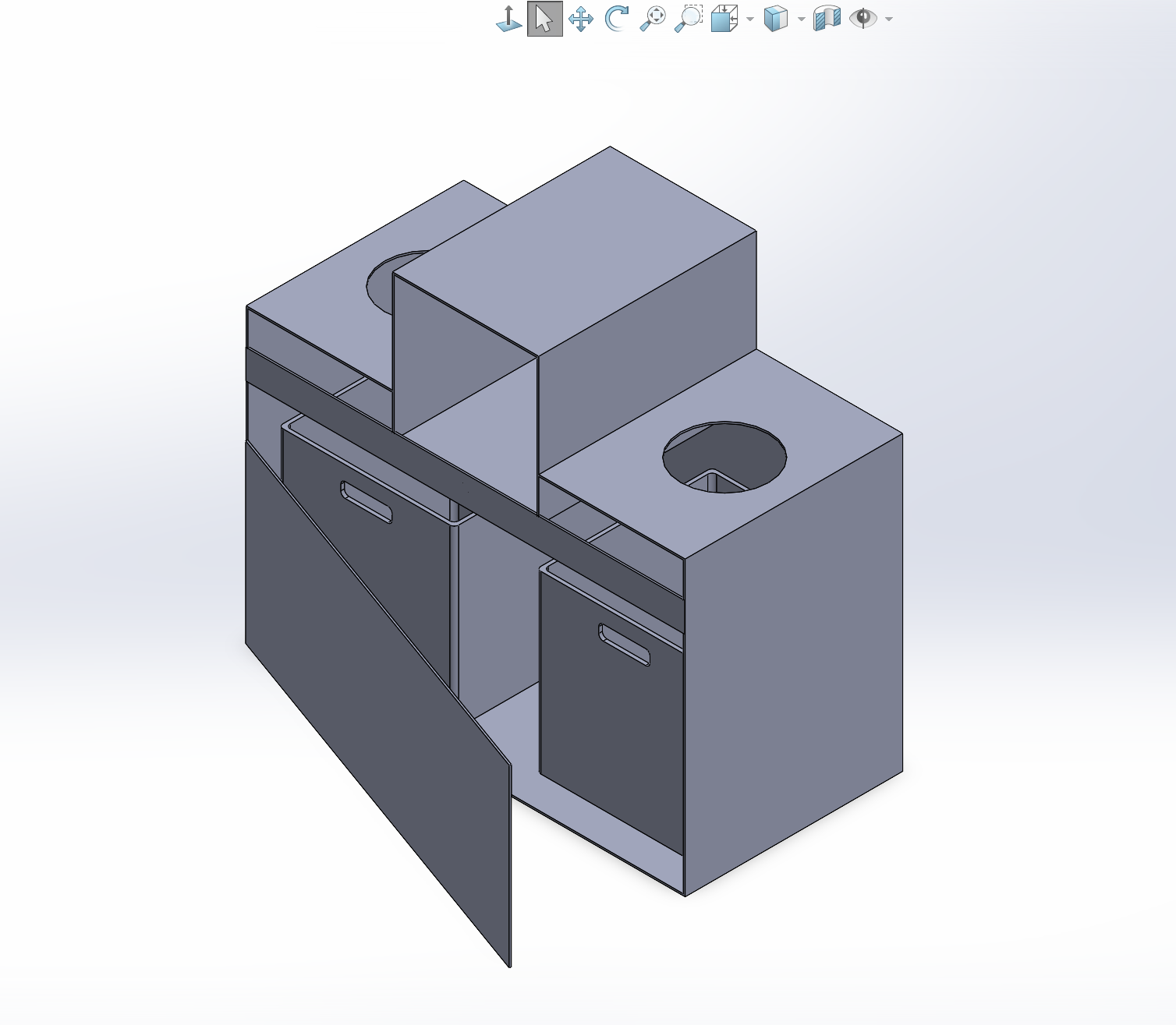
This page highlights the physical design of the Smart Sorting Trash Can, including CAD development and electrical system planning.
The smart trash can is an automated waste-sorting system that integrates mechanical actuation with a classification pipeline to direct items into appropriate disposal streams. Waste is introduced through a top intake chamber and falls onto an internal platform mounted on a hinged pivot, enabling controlled angular displacement about a single axis. Once positioned, the item is analyzed by a classification algorithm that determines whether it is recyclable or general waste. Based on this output, an actuation mechanism drives the platform to rotate laterally, altering its inclination such that the item rolls off under gravity into either the recycling or trash bin. This design leverages passive transport (gravity-driven motion) in combination with active control (hinge-based actuation) to achieve efficient, low-complexity sorting with minimal user intervention.
The CAD model was developed by first designing the overall enclosure and bin layout, followed by integrating internal components such as the intake chamber and hinged sorting platform. Parametric modeling was used to ensure proper alignment, clearances, and motion of the pivoting mechanism. Iterative adjustments were made to optimize fit, assembly, and functionality before physical prototyping.
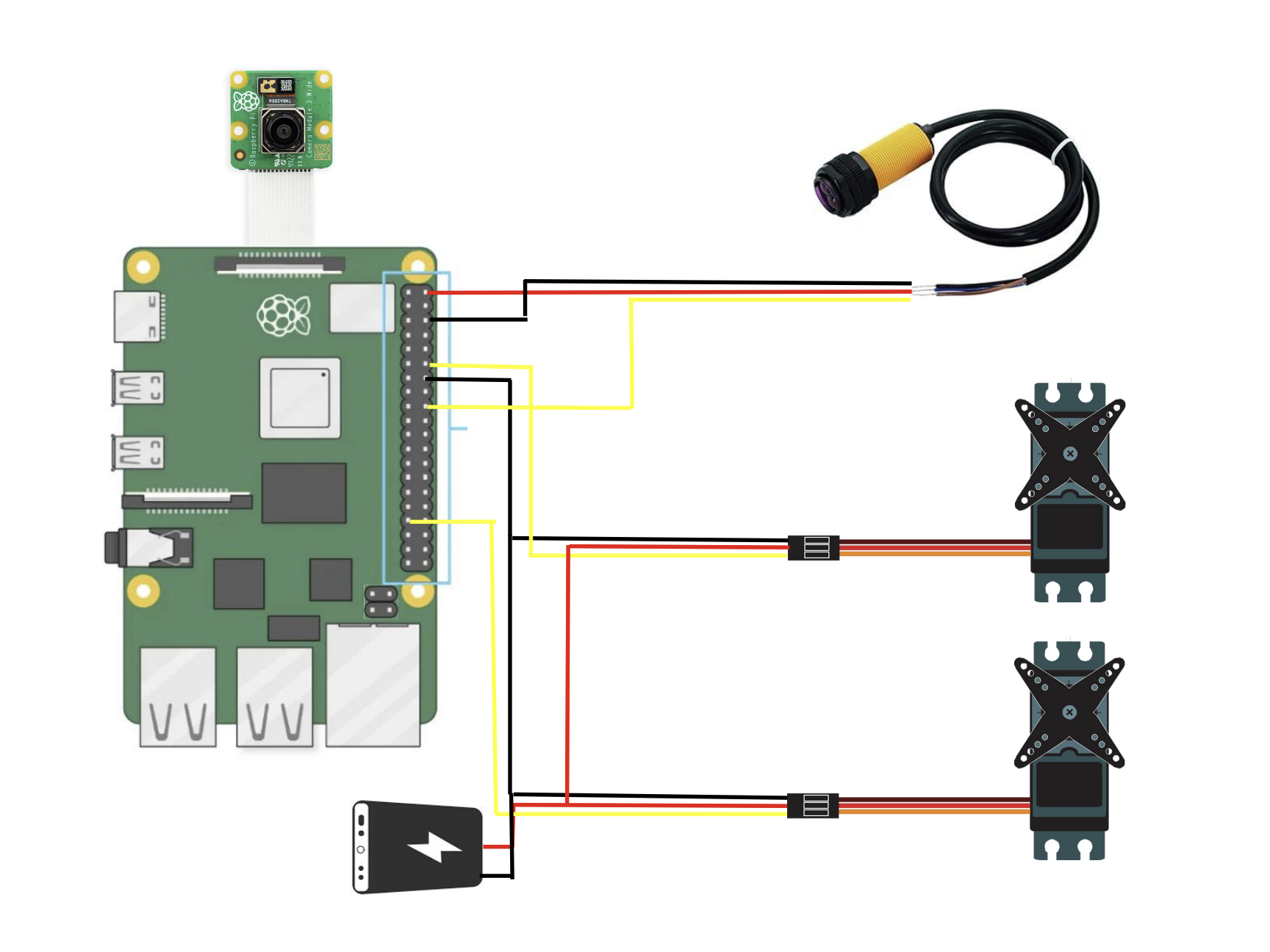
The electronic hardware is centered around a Raspberry Pi, which serves as the main controller and is connected to two high-torque (25 kg·cm) servo motors via power, ground, and PWM signal lines. These servos are physically mounted at the base of the hinged platform, allowing them to control its rotational motion. An infrared (IR) break-beam sensor is positioned at the intake chamber to detect when an object is inserted, while a camera is mounted on the lid mechanism above the intake to capture images of incoming waste. This layout ensures that sensing, imaging, and actuation components are aligned with the physical flow of the object through the system.
When an object is placed into the intake, it interrupts the IR sensor beam, generating a signal that triggers the camera to capture an image. This image is then sent through a classification pipeline, where the object is identified as either recyclable or generalwaste. Based on the classification result, the Raspberry Pi outputs a corresponding PWM signal to the servo motors, causing the hinged platform to rotate to a predefined angle in the appropriate direction. This rotation changes the platform’s inclination, allowing the object to roll off under gravity into the correct bin, completing the automated sorting process.