Model Training

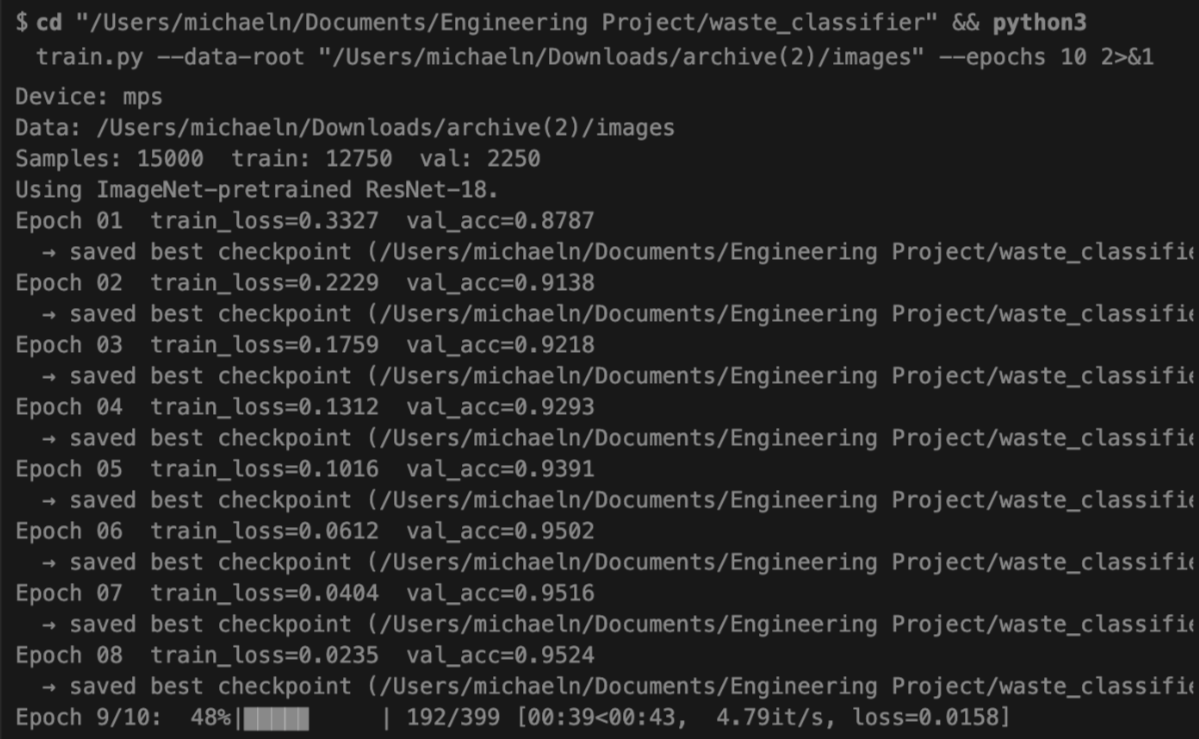
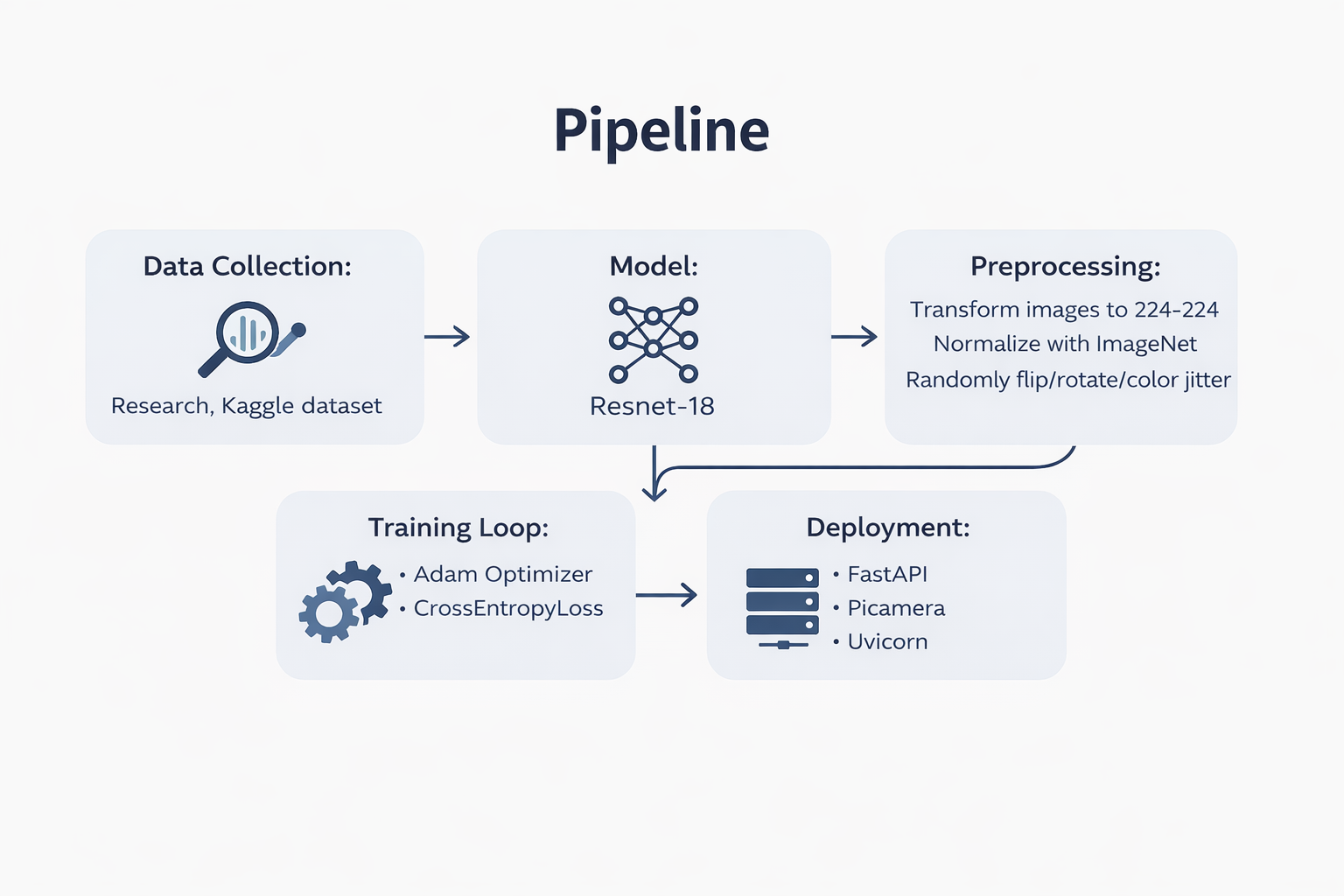
The classification model was developed using a ResNet-18 convolutional neural network (CNN) architecture, selected for its balance between computational efficiency and strong image recognition performance. The model leverages pretrained weights to improve learning efficiency and achieve higher accuracy with a relatively limited dataset.

Prior to training, all input images were standardized using ImageNet mean and standard deviation to ensure consistency with the pretrained model. Data augmentation techniques, including random jittering, rotations, and horizontal flips, were applied to reduce dataset bias and improve model generalization across varying orientations and environmental conditions.
Model Training
Pipeline Diagram

Control Logic and Prediction Flow

The system utilizes an infrared (IR) sensor to detect when an object has been placed, which triggers image capture and sends the data to a FastAPI server for processing. The trained model then retrieves the image and performs inference, outputting a classification along with an associated confidence score.

If the confidence falls below a predefined threshold, the object is conservatively classified as general waste to minimize sorting errors. The prediction result is returned to the FastAPI server, where it is accessed by the Raspberry Pi, which then generates the appropriate control signals to actuate the servo motors and direct the platform accordingly.